Digital business cards fixed the handoff and left the forgetting untouched.
The paper pile is gone and the tap is instant. What lands in your contacts is still a name, a title, and no memory of why you talked.
The tap worked. The memory didn't.
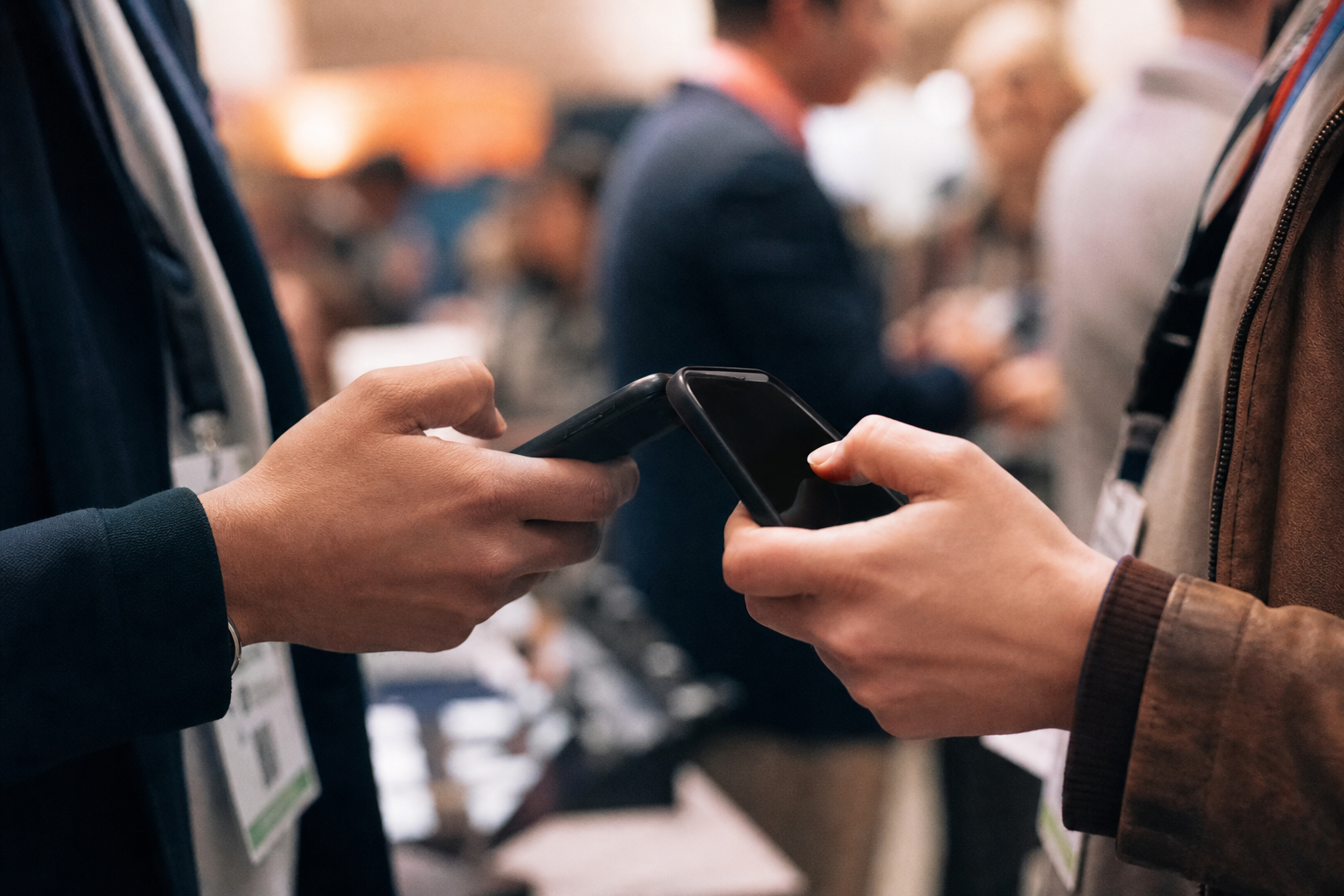
A phone touched a phone at a booth in the spring. A contact slid into your address book before either of you finished the sentence you were on. No paper, no squinting at type later, no thumbing it in by hand. Five months on, you open that contact to send the follow-up you meant to send. There's a name. A title. A LinkedIn URL. And nothing else. Not the project they were standing up, not the reason you swapped details, not the thing you promised to send over. The exchange was flawless. Every memory of what it was for is gone.
The transfer trap
Every version of the business card has spent its innovation on the same six seconds: the handoff. Paper made it physical. Scanner apps made it typo-free. The tap made it instant. Call the pattern the transfer trap. Each generation got measurably better at moving contact details from one person to another, and not one of them touched the part that actually decides whether a follow-up ever happens. That part is whether you can remember, a week later, who the person was and why you talked. The exchange got faster with every release. The forgetting stayed put.
The paper pile was never the expensive failure
Popl, HiHello, Mobilo, and Dot all pitch the same villain. The paper card. It gets lost, it goes stale the day you change jobs, it dies in a drawer with three hundred others. All true. But losing a card costs you exactly one contact. The expensive failure is the follow-up that never gets written because you're staring at a name you can't place, five days after a conference, with no idea whether this person was a buyer, a seller, or someone who just liked your badge. That happens with a pristine, perfectly synced digital contact just as easily as with a crumpled paper one. Cleaner input, identical outcome.
What a tap actually deposits in your contacts
Trace the arc and the pattern is hard to miss. Paper card: the transfer was manual, so someone built OCR to read it for you. Scanner apps: the transfer was still a two-step scan, so someone built a card that transfers on contact. NFC and QR cards: one tap, done. Three generations, each aimed squarely at the handoff. Now open your contacts after a conference floor and read what a tap left behind. A name. A title. A company. A LinkedIn URL, maybe a phone number. It reads like a line in a company directory, because a vCard is a directory entry. Nowhere in that record is the conversation you just had.
Generation
The transfer win
Still on you
Paper card
Physical, immediate hand-off
Typing it in, remembering the person
Scanner app (OCR)
No manual typing
The conversation, the reason you talked
NFC / QR card (Popl, HiHello, Mobilo, Dot)
One tap, nothing to open
Still just a vCard, zero conversation memory
Each generation optimized the handoff. The right-hand column never moved.
Forty taps, all interchangeable
Run it forward. Forty taps over two days on a demo-day floor. Sunday afternoon you sit down to work the list. Every contact is there, complete, correctly spelled, synced across your devices. And they are interchangeable. The founder who wanted to pilot your product looks identical to the recruiter who wanted to pitch you, who looks identical to the person who just liked your lanyard. Same fields, same blank. You spend the next hour reverse-engineering forty conversations from job titles, and the three that actually mattered get the same generic note as the thirty-seven that didn't. Most of the forty never get a second email at all.
You optimized the wrong six seconds
If the handoff was never the bottleneck, a faster handoff cannot move your follow-up rate. The number that decides whether the trip paid off isn't how quickly you traded details. It's how many of those people you can still place seven days later, with enough context to write something they'll actually reply to. Speed up the exchange and leave recall untouched, and you get a beautiful, complete contact list that nobody follows up on. The prettier the list, the more it hides the gap.
The bottleneck was never the exchange. It was everything you forgot after it.
The generation the category skipped
The capture that matters happens during the conversation, not at the moment of exchange. One line while the room is still loud: what they're building, the thing you promised to send, whether they're a buyer or a seller. A voice note dictated on the walk to the next booth. That context, pinned to the person before it evaporates, is the generation the card category skipped entirely. It's unglamorous. There's no satisfying tap, no animation. But it's the only part of the whole exchange that was ever load-bearing for the follow-up, and it stays with you instead of living on someone else's server.
What we're tracking next
A few NFC card makers have started bolting a notes field onto the tap. Worth watching whether that retrofits memory onto a model built to optimize speed, or whether context capture has to be the starting point rather than an afterthought. The tell will be default behavior. Does the product make you stop and remember while the conversation is fresh, or does it just let you tap and move on to the next booth, exactly as before.
Capture the conversation, not just the contact. Get Met.
The people who work a conference floor hardest are the ones who learn this the expensive way: a full contact list is not a full memory. The fix isn't a faster card. It's capturing the conversation while the room is still loud, kept on your own device instead of sold to anyone.