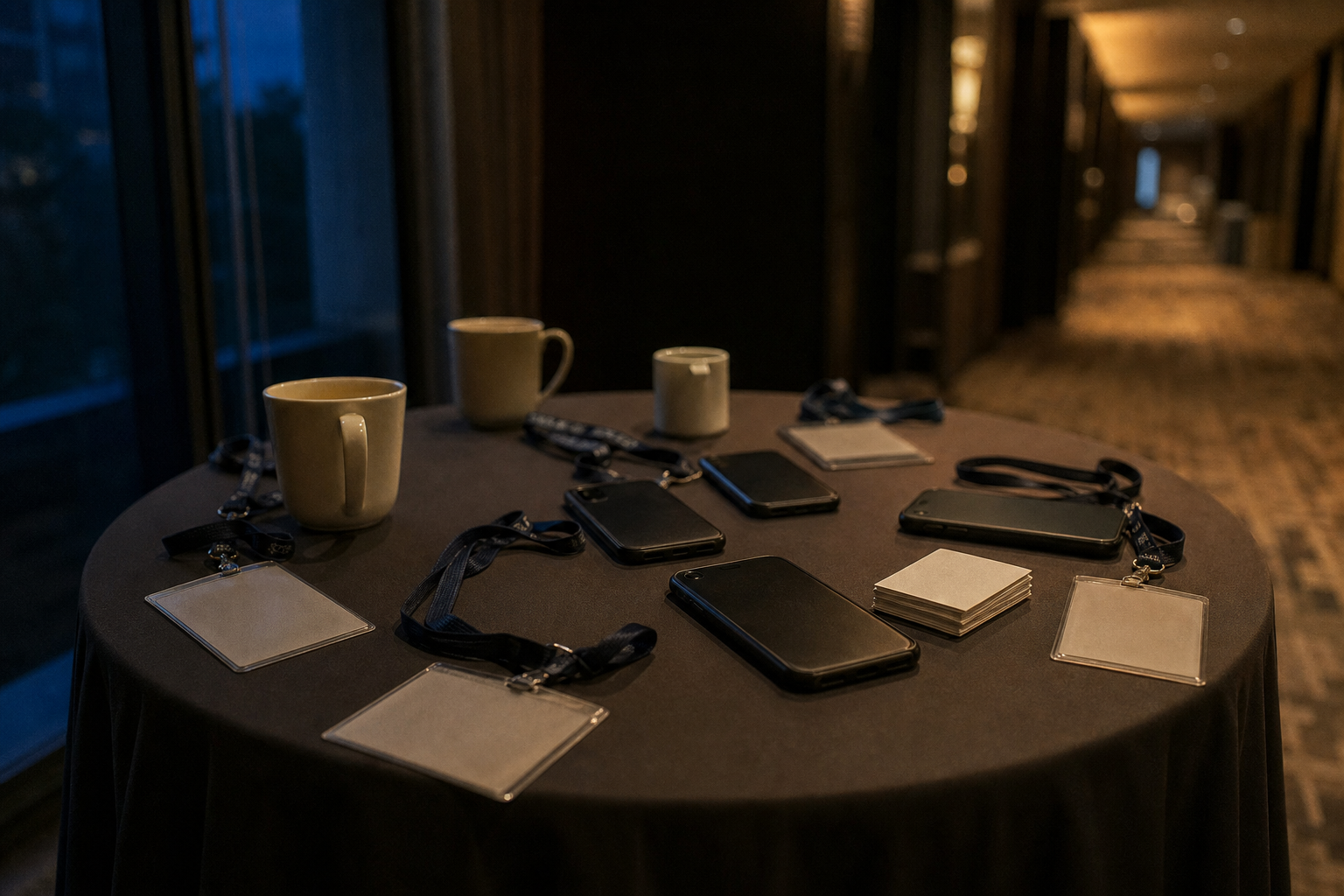
Five colleagues, one conference, zero follow-ups: the Five-Phone Problem.
When a team works a show, each person's context lives in their own phone. The follow-up doesn't fail from laziness. It fails because nobody sees the whole room.
The account got three messages, and none were the right one
The Tuesday after the conference, a director at one of your target accounts opens their inbox. There's a LinkedIn request from your AE with no note. There's a two-line email from your founder saying it was great to connect. And there's nothing from the solutions engineer who spent twenty minutes at the coffee station walking through the exact integration problem that director is trying to solve.
Five people from your company flew in. Between them, they had real conversations with the people you went there to meet. By Friday, the team will agree it was a good show.
Nobody will be able to say who owns the director.
The Five-Phone Problem
Call it the Five-Phone Problem. When a team works a conference, the context from every conversation lands wherever it was closest: a photo of a badge, a note typed between sessions, a contact saved with no detail, a card in a jacket pocket. Each capture is fine on its own. But the team's picture of the event is just five private piles that nobody else can see.
So the follow-up problem compounds with headcount. Two people meet the same buyer and each assumes the other will write. A useful conversation happens with one colleague, and the person best placed to follow up never hears about it.
A solo attendee with a stack of cards needs discipline. A team of five needs a way to see each other's stacks.
Why follow-up advice written for one person misses the team
Almost all post-conference advice is written for an individual: follow up within a day or two, reference something specific, skip the template. It's good advice. We've made the individual case ourselves in The 72-Hour Memory Cliff, on why the window after an event closes fast.
That advice quietly assumes two things. The person holding the contact is the right person to follow up, and nobody else from their company is also writing. On a team, both break. The fastest, most specific email in the world still lands badly if it's the second one that week from the same company, with a different ask, from someone the buyer barely remembers.
Tell five people to be more disciplined and you get five disciplined, uncoordinated follow-ups. The failure isn't effort. It's that there's no agreed moment where what each person captured becomes visible to everyone else.
Three ways team follow-up breaks
The demand shows up where event-heavy marketers talk shop. On r/marketing, people who manage a heavy conference calendar describe the same problem. Nobody staffs that alone. At that volume the booth, the dinners, and the hallway meetings get split across a rotating crew, and the follow-up gets split with them.
When it breaks, it usually breaks in one of three shapes.
No shared capture layer. Each person's context lives on their own phone, so the team can't see who met whom, let alone what was said.
No ownership assignment. Two colleagues both met the same BD contact, and neither knows the other did. Each waits. Or each writes.
Contradictory outreach. Different messages, different timelines, sometimes different asks, all reaching the same person from the same company. To the buyer, it reads as a company that doesn't talk to itself.
Pattern
What it looks like the week after
What it costs
The lightweight fix
No shared capture layer
Context sits in five phones and five memories
The team can't spot duplicates or hand anyone off
Everyone brings captured contacts, with notes, to one sync
No ownership assignment
Two people met the same buyer; neither knows
The contact gets two follow-ups or none
Whoever had the substantive conversation owns the contact
Contradictory outreach
Different asks and timelines reach one person
The buyer's view of your company is set by the messiest message
One owner, one message; colleagues add context, not extra emails
The Five-Phone Problem, pattern by pattern. Category-level framework, not vendor-specific.
How should a team handle conference follow-up?
Take the same five-person team and change one thing: a fifteen-minute sync the morning after the last session, before anyone sends anything.
Each person brings their captures with notes attached, not just names. The team reads the list once, fast. Duplicates surface right away: the AE and the SE both met the director. Ownership follows one rule. Whoever had the substantive conversation writes, and everyone else stays out of the inbox or adds a line to that person's draft. Contacts that belong in someone else's lane get handed off with the context intact: what was discussed, what they asked for, what was promised.
Then each owner writes one message. The director gets a single email from the SE about the integration question, with the AE copied if a commercial conversation is the logical next step.
None of this needs a CRM rollout or a new project board. It needs two things to be true before the sync. Every person captured context at the moment of the conversation. And the sync happens while that context is still fresh.
The buyer didn't meet five people. They met your company.
What changes if the problem is coordination
A few things follow. Sending more people to an event doesn't automatically multiply what it produces. Without a handoff moment it can shrink it, because the buyer's read on your company gets set by the worst message they receive.
The measure of a good show moves too. Cards collected tells you very little. What counts is whether every warm conversation ended the week with exactly one owner and exactly one follow-up.
And capture quality becomes the bottleneck. A sync is only as good as what people carry into it. A name and a job title can't be handed off. A name, the problem they described, and the thing you offered to send? That can.
Where the team's capture layer starts
Met is built for the individual end of this, the moment of capture. Event Mode keeps the room captured while you keep talking, so the detail from a hallway conversation is attached to the contact instead of trusted to memory until the flight home. Your contacts stay in your own iCloud, not on someone else's server.
That's the raw material a team sync runs on. When each of the five walks into the morning-after meeting with contacts that carry what was actually said, duplicates are obvious, handoffs come with real detail, and the owner can write a follow-up that references the conversation the buyer remembers.
The team rule is yours to set. Pick the sync time before you fly out. Agree that whoever had the real conversation owns the contact. And make sure everyone on the floor captures context, not just names.
Capture the conversation, not just the card. Get Met before your team's next show.
Team follow-up breaks when context stays locked in each attendee's head or phone. Met captures what was said at the moment you meet someone, with Event Mode running while you keep talking and contacts stored in your own iCloud, so every person on your team brings something real to the morning-after sync.